I’ve gone to St. Joseph University Parish pretty much whenever I’ve been in Terre Haute, IN. It is the University Parish, and my understanding is that, since it is the home to the campus ministry programs at Rose-Hulman (among others), it is my spiritual home. St. Joseph’s has been the cause for much spiritual development in my life since first setting foot there back in 2006, and I have many fond memories of good friends and acquaintances. Having been through two pastors there (Fr. Richard and now Fr. Mark – who, by the way, needs prayers for some medical stuff he’s going through now!), a handful of campus ministers, and far too many academic classes, it’s stayed surprisingly constant.
But, one thing that has always fascinated me and ran through my mind in the countless Sundays I’ve spent assisting at Mass there, though, is what the church had looked like throughout the decades.
I had heard rumors that there were saint statues or images in the alcoves in the sanctuary, that the altar reredos had been far more majestic and grand in the times before the Council and all its baggage, that this or that thing had been different.
But, alas, my luck in finding old photos of the church proved fruitless, so it stopped occupying my mind for some time. Except… when I got bored last week and decided to hit up the Indiana Historical Society Digital Image Collection! Apparently, I never looked all that hard, because these photos have been on IHS’s site since 2006.
Here is what the church looks like now (click for full-size).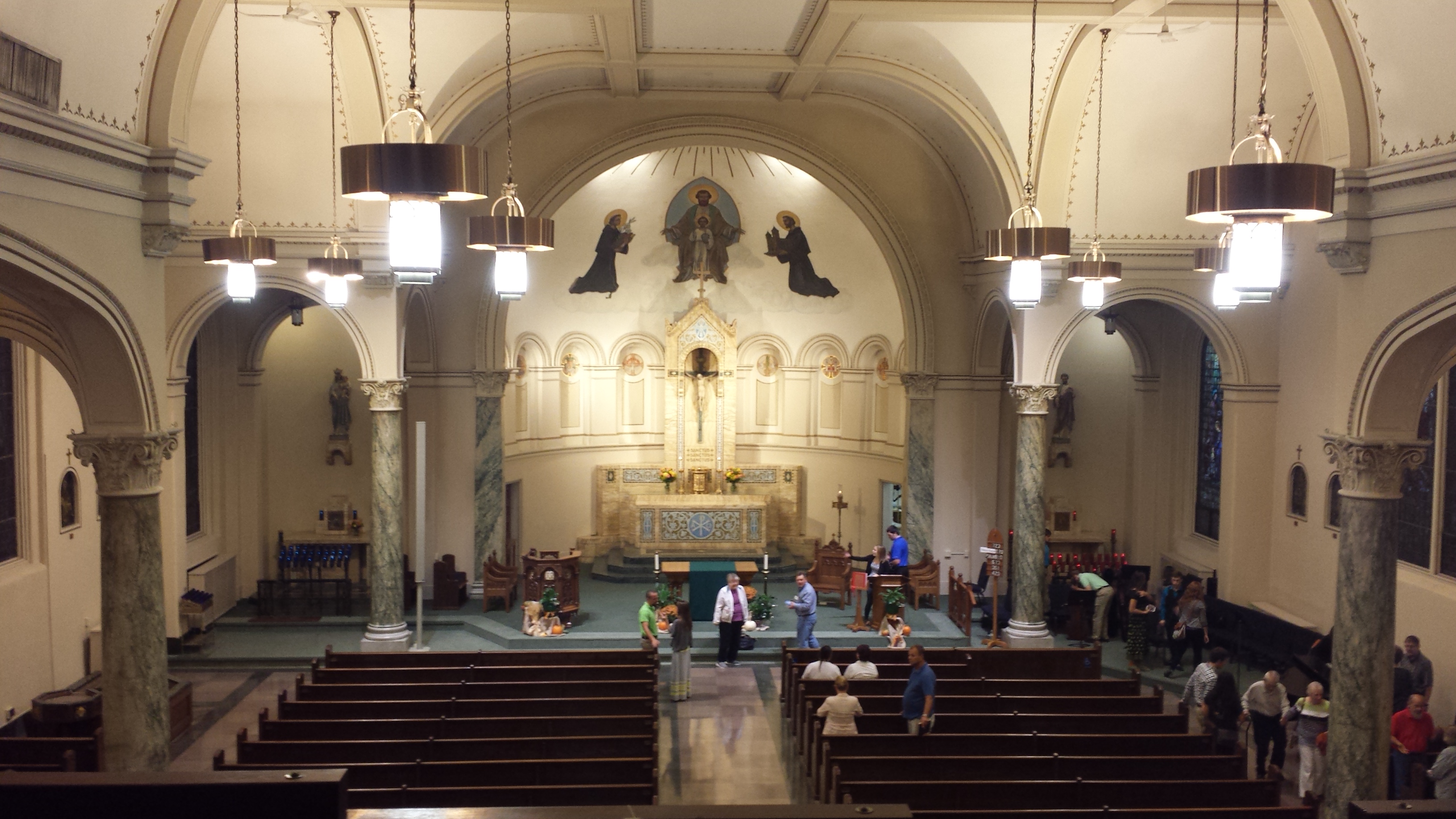
Honestly, it doesn’t look all that bad, aside from that horrid green carpeting. It’s a rather modest, but beautiful church, in its own right. I had always wondered (hoped?) that the ceiling was a bit more embellished than it currently is, because as we know, the post-conciliar time has seen something of an iconoclasm ravage beauty and ornamentation. But, for a church building that has been standing for over 100 years, has survived a 1934 fire, and gone through the post-conciliar changes, I think it’s survived surprisingly well!
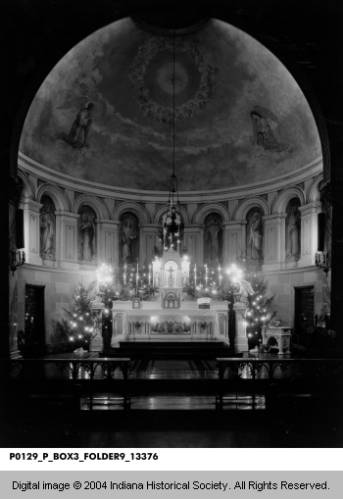
Here are photos of the church interior prior to the 1934 fire. This was taken in December 1932, as the altar was prepared for Christmas. The collection belongs to the Martin’s Photo Shop Collection. In the photo, you can see the sanctuary light hanging from the ceiling (wonderful!), and you can see a painting in the apse’s semi-dome of the Holy Spirit (in dove-form), a host of angels, and two angels kneeling in prayer. Behind the altar, you can see a number of saints (nine), with the altar, two angels holding lights, and the rest of the sanctuary.
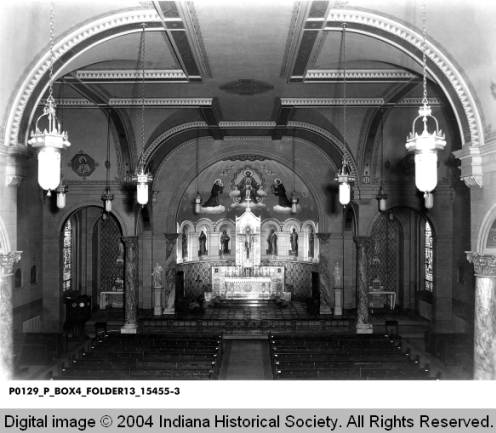
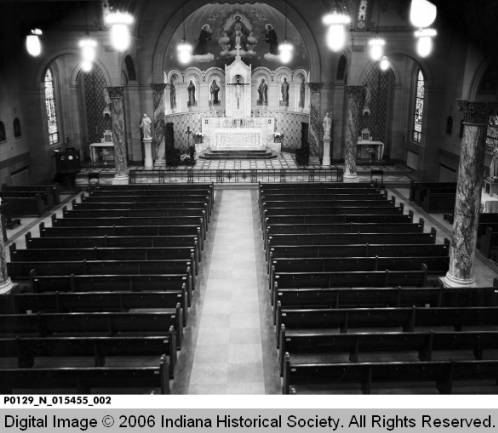
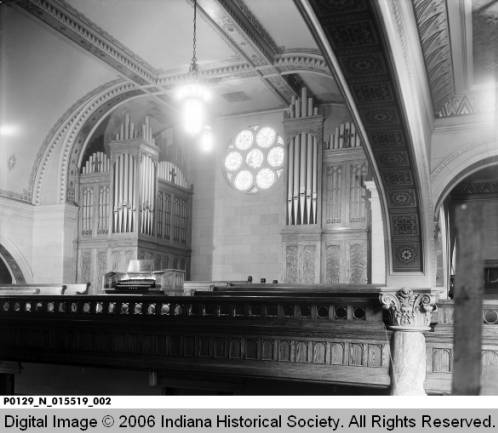
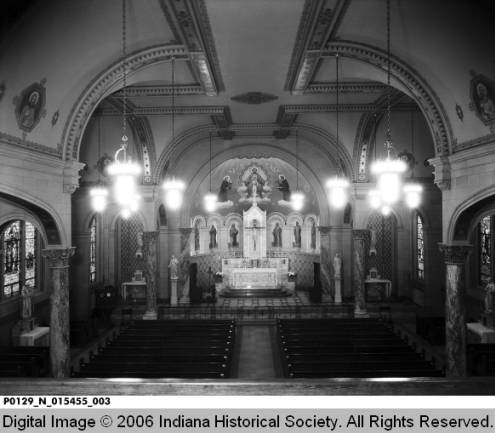
And now below, you can see the post-1934 fire church! Taken two years after the photos above, these are photos from December 1934. Remarkably, there has been little change to the church in the last 80 years. Of the changes I can pick out, the church walls and ceiling was decorated a little bit more than it is now. The image in the ceiling at the intersection/middle remains, but the small icons are gone, which is sad. I’m not sure who the saints are, but I would venture they are Franciscan saints (Conventual Franciscans currently run the parish, after it passed through the hands of diocesan clergy, the Jesuits, and then the Benedictines). You will note the greater embellishment of the semi-dome, something I do wish they would restore. It lends a greater gravitas to have the Divine Infant and St Joseph surrounded by angels, as opposed to just chillin’ on some clouds (I think that’s what are those little head-like things floating around the saints).
The embellishment of the sanctuary (those patterns behind the altar and the side altars) would help make them “stand out” a bit more – as it is now, most of the walls get blurred into that liturgical-bland color. It would be a great boon to that church to remove that hideous green carpeting and show forth the beauty of that tiled sanctuary! Interestingly enough, it seems as though the pulpit was kept intact, but now moved to its customary spot in the post-conciliar times. Sections of the altar rail have been preserved and are now positioned in front of the side altars for devotional use (if you ask me, I’m ambivalent on them – they should be of a more substantial form…). I do have to wonder whatever was done with the side altars, and where those two saint statues got off to from in the sanctuary… And, while I do like the saint paintings in the sanctuary of old, I do also like the sacramental symbols of today. They are tasteful, beautiful, and modest. It’s also rather (traditionally) symbolic, as you’ve got baptism, confession, and confirmation on the Gospel side, then holy matrimony, holy orders, and extreme unction on the Epistle side, with the Eucharist and Christ on the Cross in the center.
It looks as though the organ is definitely the same as it was in 1934. Interesting enough, there are still pews up there now, as they were in 1934. However, they have added a make-shift railing addition, so folks don’t fall over the (somewhat low) railing. And, the pews look to be the same, even with their little (hat?) clips spaced two per section.
I do wish the ornamentation on the undersides of the arches and dividers were restored, though. It’d give a bit more regality to the church, and save it from a … less-distinct appearance.
Can anyone discern what is on the Gospel side of the sanctuary next to the pillar? It looks like a sort of sedilia with a kneeler?

No Comment Yet